EndoPel Biologics has developed a proprietary computational platform that leverages artificial intelligence and machine learning to design novel chimeric endolysin architectures optimised for therapeutic performance.
Natural endolysins, while effective, often have limitations in stability, catalytic efficiency, or spectrum of activity. Our platform overcomes these challenges by computationally designing chimeric constructs that combine the most effective enzymatically active domains (EADs) with optimised cell-wall binding domains (CBDs), connected by engineered linker regions.
This AI-first approach dramatically reduces the traditional design-build-test cycle, enabling us to explore a vastly larger sequence space than conventional methods. From this work we have validated multiple active chimeric endolysins, which are combined into our lead candidate EPB-101 — a formulated, multi-enzyme biologic that would be impossible to discover through empirical screening alone.
Our platform follows a rigorous six-step process from computational design through to clinic-ready therapeutics.
AI-powered analysis of thousands of phage-derived endolysin structures to identify optimal domain architectures and catalytic mechanisms.
Computational assembly of novel EAD-linker-CBD configurations, optimising for binding affinity, catalytic turnover, and thermostability.
Machine learning models predict protein folding, solubility, and activity — dramatically reducing the experimental design-build-test cycle.
AI-guided optimisation of topical formulations for skin penetration, enzyme stability, and sustained release at the infection site.
Rapid wet-lab validation of computationally designed candidates against clinical isolates of S. pseudintermedius, including MRSP strains.
Experimental data feeds back into the AI platform, continuously improving predictive accuracy and accelerating the path to clinic-ready therapeutics.
Traditional protein engineering relies on time-consuming empirical screening of limited variant libraries. Our AI-driven approach fundamentally changes this paradigm.
By leveraging deep learning models trained on vast protein structure databases, we can predict the functional properties of endolysin variants before they are ever synthesised. This enables us to explore sequence spaces orders of magnitude larger than conventional approaches, identifying candidates with properties that would be virtually impossible to discover through random mutagenesis or rational design alone.
Reduce the design-build-test cycle from months to weeks by computationally screening thousands of chimeric architectures before wet-lab validation.
Explore vastly larger sequence spaces than empirical methods, identifying high-performance candidates invisible to conventional screening.
Simultaneously optimise for catalytic activity, thermostability, solubility, and formulation compatibility — balancing trade-offs that challenge traditional approaches.
Every experimental result improves the platform’s predictive models, creating a flywheel effect that accelerates future design cycles.
Behind every claim on this page is a validated wet-lab result. This section shows the current state of the platform—what we’ve computationally designed, what we’ve built, and what we’ve shown kills Staphylococcus pseudintermedius in our own laboratory.
From a computational design space of over 2,380 candidate chimeric architectures, the platform down-selects, synthesises, clones, and experimentally validates. Each stage filters for the properties we need: predicted folding, catalytic plausibility, species-binding profile, and real-world lytic activity.
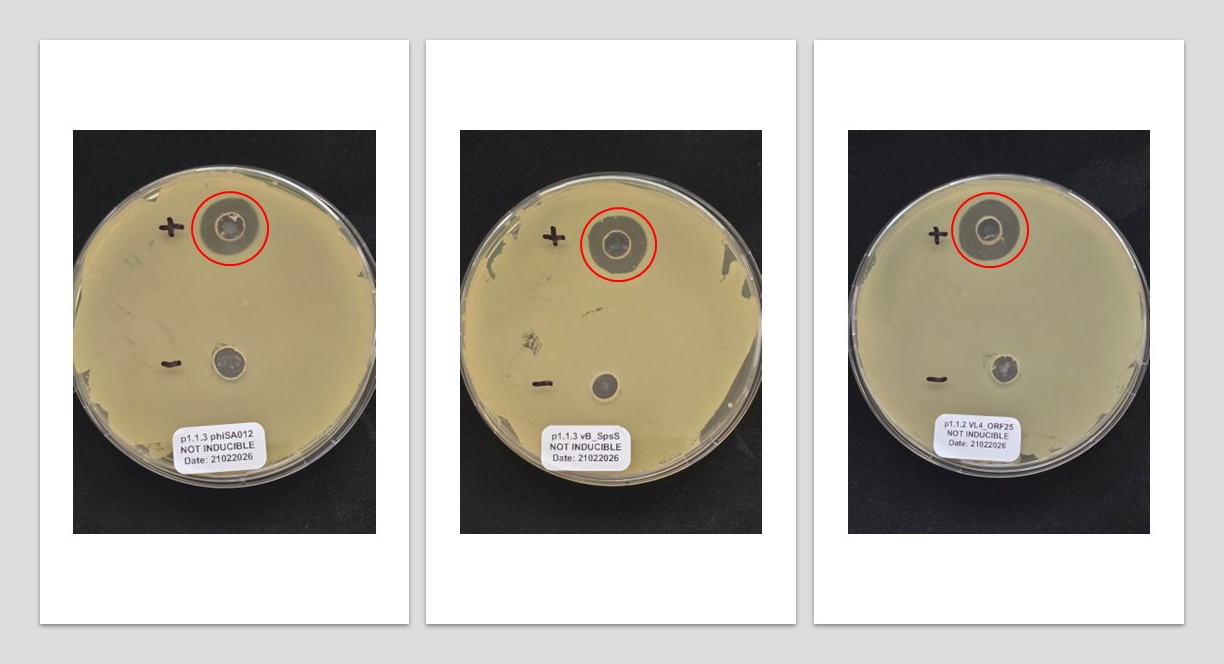
Three reference endolysins (phiSA012_ORF51, vB_SpsS_QT1, VL4_ORF25) cloned from published phage genomes into our expression system. Each produces a visible zone of clearing (red circles) on an agar lawn of our clinical S. pseudintermedius isolate. These plates validated the expression pipeline and established the baseline activity we engineer against.
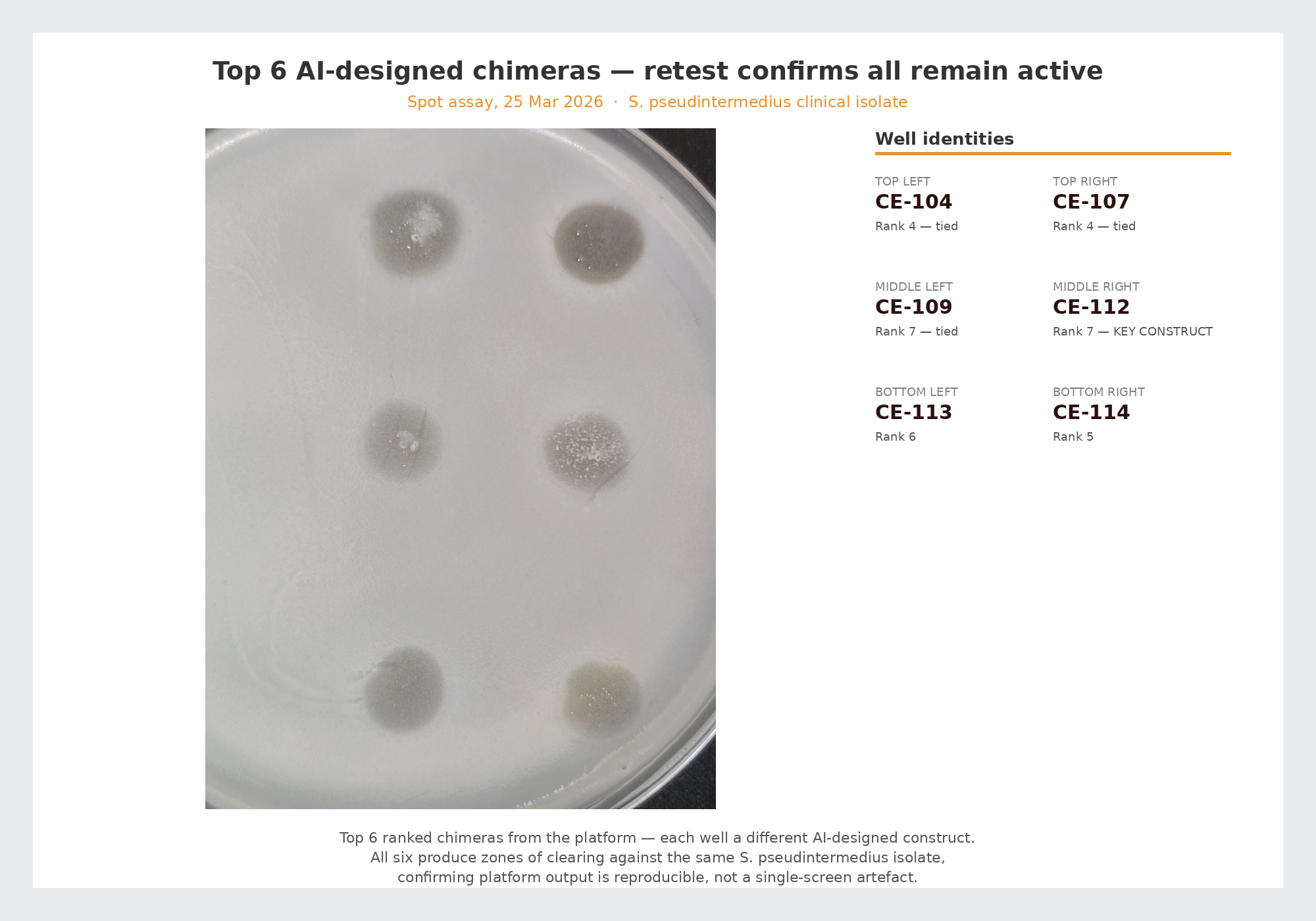
The top 6 AI-designed chimeric endolysins from the platform’s ranked output (CE-104, CE-107, CE-109, CE-112, CE-113, CE-114) retested on a single plate. All six produce zones of clearing against our clinical S. pseudintermedius isolate. Each is a novel EAD+EAD+CBD architecture that does not occur in nature. This is the platform proving its output is reproducible—not a single-screen artefact.
Qualitative kill activity is the starting point. The more important question is whether our AI-designed chimeras perform as well as the naturally occurring endolysins they were engineered from. Head-to-head minimum inhibitory concentration (MIC) and turbidity-based lysis assays—same plates, same conditions, normalised protein amounts—are currently running against our clinical S. pseudintermedius isolate.
Preliminary results across multiple chimeras and multiple replicates indicate that platform-designed chimeras match the activity of their wild-type parent endolysins, and in some cases exceed it. Formal numeric characterisation continues through the next quarter; complete results will be reported in the company’s upcoming technical update.
We welcome conversations with potential partners and collaborators.
GET IN TOUCH